SmartJudge Press Pack
Everything you need to write about SmartJudge: boilerplate you can paste as it stands, the facts we can stand behind, downloadable logos and a full sample report, and straight answers to the questions journalists actually ask. Press contact: hello@whatwouldajudgesay.com.
What makes SmartJudge different
This is usually the heart of the story, so it is worth being precise. Four things separate SmartJudge from a general-purpose chatbot and from the other divorce calculators online.
1. It starts from the law a court actually applies
Every assessment is anchored to section 25 of the Matrimonial Causes Act 1973 and works through the leading England and Wales cases that shape how it is interpreted, using the user’s own figures. A calculator that splits assets 50/50 is not modelling what a judge does; SmartJudge is built around the statutory factors a judge is required to weigh.
2. A citation guardrail, so the law cannot be invented
Every case cited is checked against a vetted list before it can appear in a report. A citation that is not on the list blocks the report rather than being published. This is the difference that matters most for an AI story: a general chatbot can state a fabricated authority with complete confidence, and its grounding goes stale with its training data.
3. It asks about finances, not identity
Most tools of this kind want an email address or a phone number before showing anything. SmartJudge asks for no name, no postal address and no contact details to produce a report. The full report is free, with nothing held back and no follow-up marketing.
4. It is built for someone in distress, not for a lawyer
The questionnaire can be completed in stages at the user’s own pace, progress is always visible and saved, and a chatbot is on hand throughout to explain any field in plain English. People use this at one of the worst points in their lives; the design assumes that.
There is more detail on each point at smartjudge.ai/why-smartjudge, and the full FAQ, twelve answers covering the law, privacy and the limits of AI, is at smartjudge.ai/faq.
Boilerplate - copy and paste
Three lengths of the same description. All three are cleared for publication exactly as written, so there is no need to run them past us first.
One line
Short, about 40 words
Full, about 115 words
How it works
- The user confirms their divorce falls under the law of England and Wales. If it does not, SmartJudge will not produce a report.
- They complete a structured questionnaire covering property, pensions, savings, investments, income, debts, children, and the length of the marriage.
- SmartJudge assesses the answers against the section 25 factors of the Matrimonial Causes Act 1973, drawing on a curated set of England and Wales authorities rather than on whatever a general-purpose chatbot happens to recall.
- It returns a plain-English report: a probable asset-split range, the reasoning behind it, the case law relied on, and the points a judge would be most likely to press. This takes about a minute.
- The report is free. From it, the user can optionally book a paid solicitor review or a written opinion through Paradigm Family Law.
Key facts
| Product name | SmartJudge |
| Company | What Would a Judge Say? (registered as WHATWOULDAJUDGESAY LTD) |
| Company number | 15937694 |
| Registered office | Corner Oak, 1 Homer Road, Solihull, West Midlands, B91 3QG |
| Correspondence address | Blackwell House, Guildhall Yard, London EC2V 5AE |
| ICO registration | ZB810938 |
| Jurisdiction covered | England and Wales only |
| Launched | 2026 |
| Cost to the user | Free at the point of use; optional paid reviews (see below) |
| Report turnaround | About one minute |
| Technology | Anthropic Claude, applied to a curated set of England and Wales authorities |
| Data location | Google Firebase, London region (europe-west2) |
| Legal partner | Paradigm Family Law |
| App | smartjudge.ai |
| Company website | whatwouldajudgesay.com |
What it costs
The assessment and the report are free. No card details are taken and there is no trial that converts into a subscription. Two paid options are offered afterwards, both delivered by Paradigm Family Law, and neither is needed to get or keep a report. Prices include VAT.
| SmartJudge report | Free |
| Solicitor review | £300 |
| Written barrister’s opinion | £1,800 |
| Written judge’s opinion | £3,600 |
Questions journalists ask
Why not just use ChatGPT?
A general-purpose chatbot only knows what the user happens to tell it, has no reliable way of judging which authorities matter for a particular set of facts, works from a frozen training snapshot, and can state fabricated citations with complete confidence. SmartJudge uses large language models too. The difference is the scaffolding around them: a structured questionnaire so nothing material is missed, the section 25 framework as the analytical spine, a curated body of England and Wales authorities, and a citation check before anything reaches the user.
How do you stop it inventing case law?
Every citation in a report is checked against a verified list before the report is released. A citation that is not on that list blocks the report rather than being published. This is the failure mode we treat most seriously, because a confidently fabricated authority is worse than no authority at all.
Is this legal advice?
No, and we would ask you not to describe it as such. SmartJudge is an educational tool that produces an informed starting point. It is not a law firm, it is not regulated as one, and a report is not a prediction of what will happen in any particular case.
Does a lawyer check the legal content?
Yes. A practising family law solicitor at Paradigm Family Law reviews the legal framing and signs off changes that affect it. We can put you in touch for an independent view.
What do you do with the financial data people enter?
It is stored encrypted in the London region, used only to produce that user’s report, never sold, and deletable by the user at any time. The email address someone signs up with is a username rather than a marketing list, and it can be a made-up address. We do not ask for a name or postal address unless the user chooses to complete a Form E.
Can someone run their spouse’s finances through it?
Not from their spouse’s paperwork. Users can upload their own Form E but never the other party’s. That is a deliberate legal boundary rather than a missing feature.
How do you make money if the report is free?
Through the optional paid reviews listed above, delivered by Paradigm Family Law. The free report is complete in itself; nothing is withheld to force an upgrade.
Quotes and interviews
Our spokesperson is Karen Arndt, Founder, who is available for interview. The quote below may be used as it stands, attributed to her. For anything on deadline, email hello@whatwouldajudgesay.com with “Press” in the subject line and say when you need it by. We can also arrange an independent comment from a family law solicitor at Paradigm Family Law if you would rather not rely on ours.
Attributable quote
Karen Arndt, Founder, SmartJudge.ai
Downloadable assets
Everything here may be reproduced in editorial coverage of SmartJudge without asking us first, provided it is not altered and does not imply that we endorse a third party. Right-click and save, or click to open.
The example report
This is the single most useful thing on the page if you are writing about what SmartJudge actually produces. It is a complete report from anonymised figures, exactly as a user receives it: the asset-split range, the reasoning, the authorities relied on, and the contested points.
Example SmartJudge report (PDF, 34 KB)
Screenshots
Captured at 2x for print. Click any image for the full-resolution file.
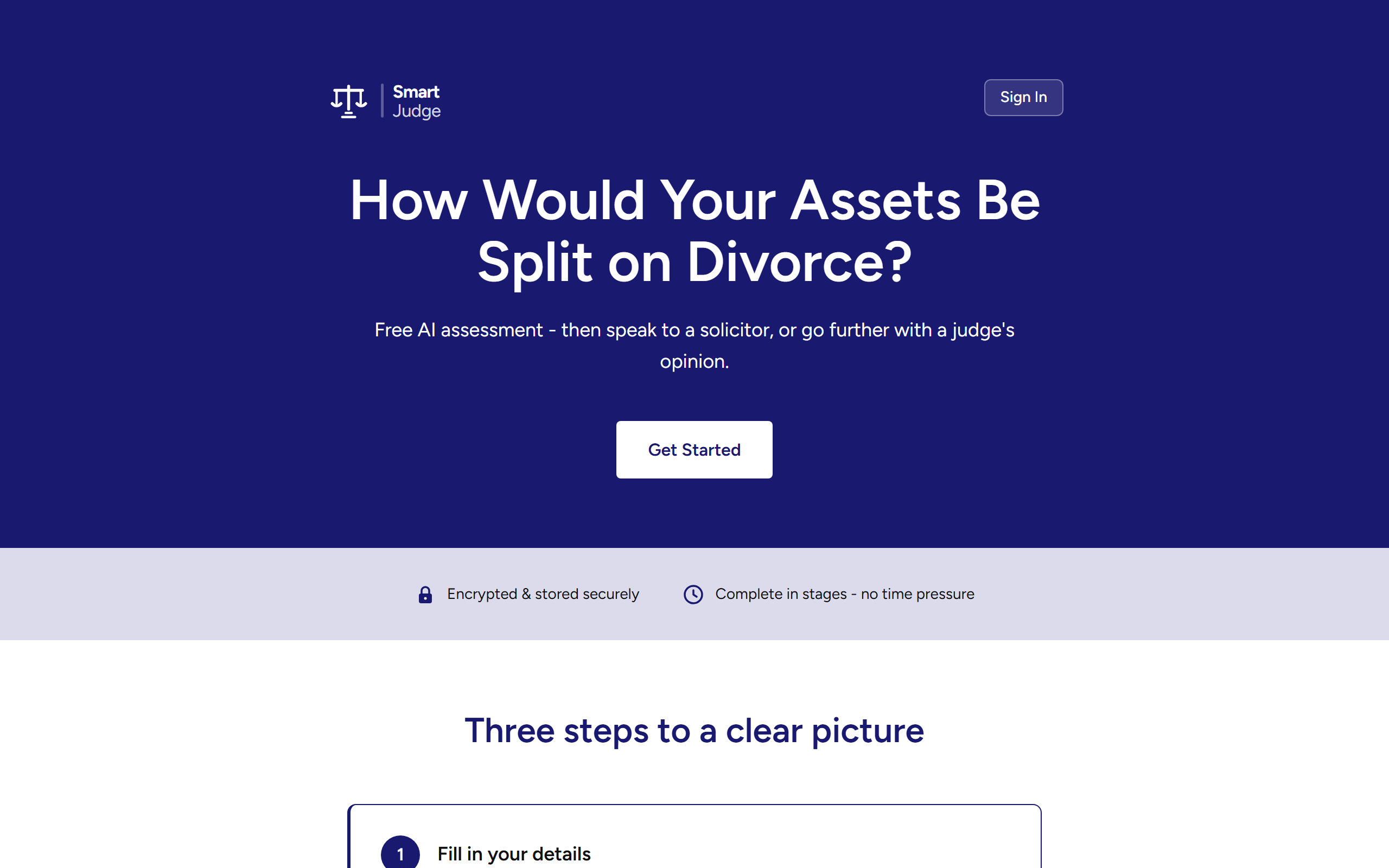 Home, desktop
2560 × 1600, 116 KB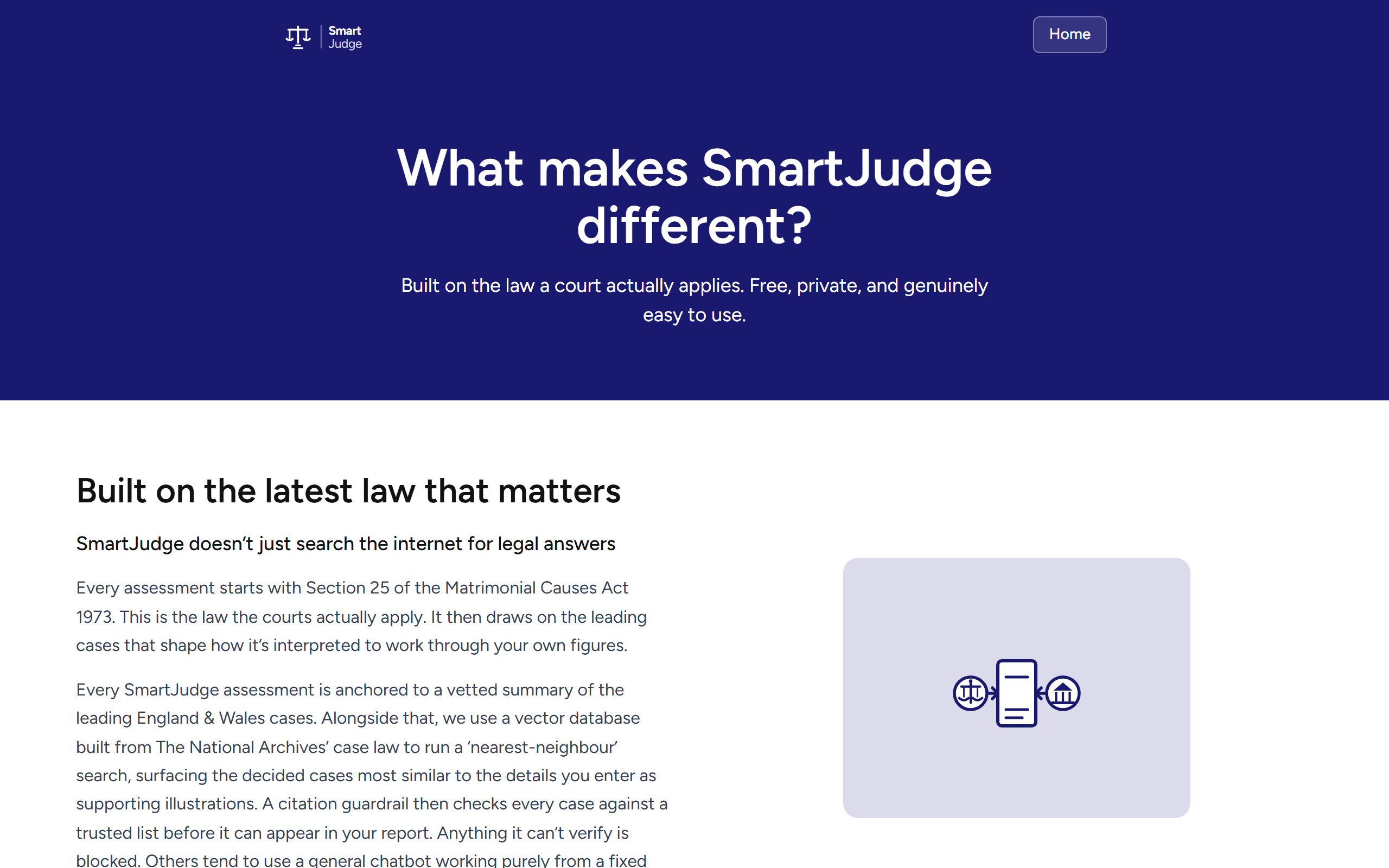 Why SmartJudge, desktop
2560 × 1600, 219 KB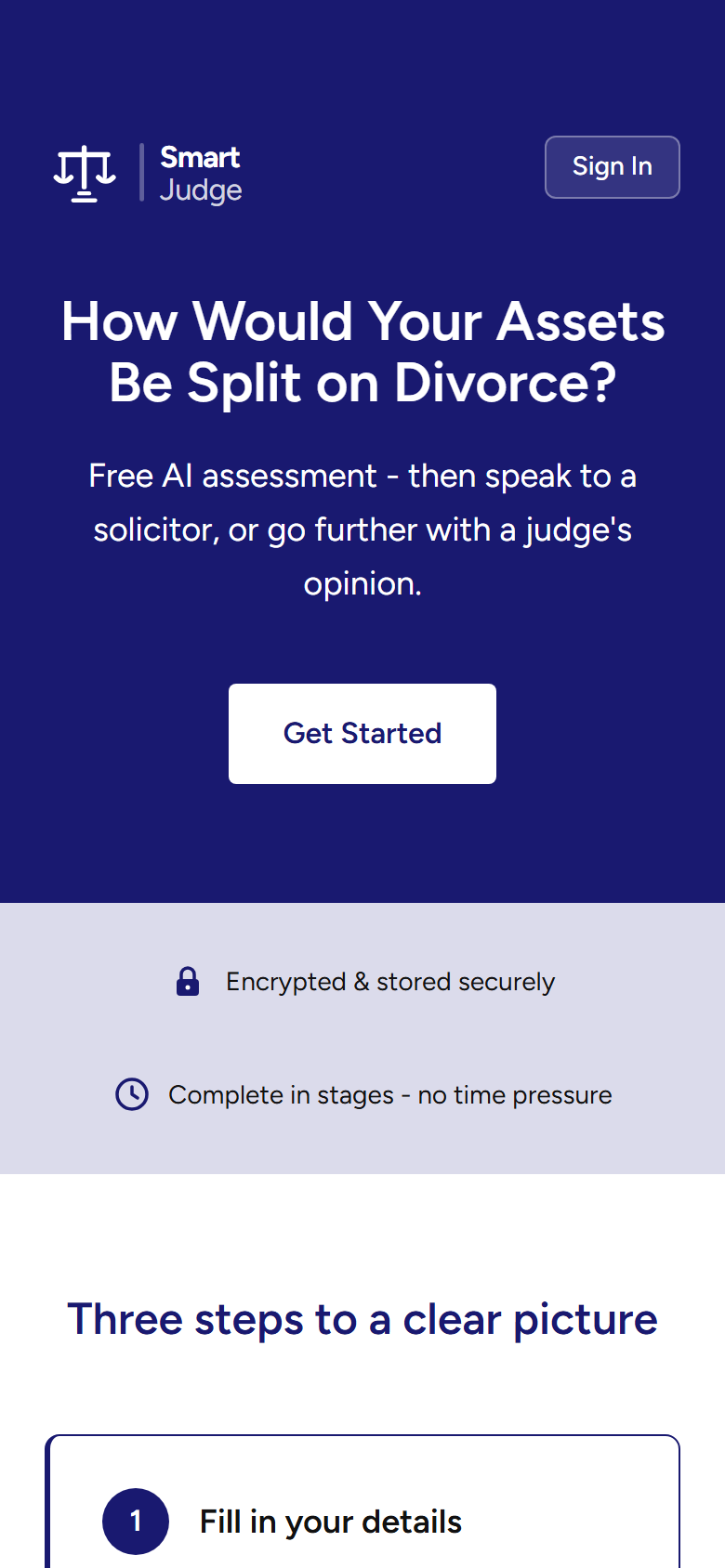 Home, mobile
780 × 1688, 85 KBLogos and icon
| SmartJudge logo, midnight blue (SVG) | For light backgrounds. Preferred. |
| SmartJudge logo, white (SVG) | For midnight or dark backgrounds. |
| App icon, 512px (PNG) | Square, midnight-blue background. |
| What Would a Judge Say? logo, midnight blue (SVG) | The company, not the product. |
| What Would a Judge Say? logo, white (SVG) | The company, on midnight or dark. |


The wordmark in the SVG logos is set in Figtree. Without Figtree installed it falls back to Helvetica or Arial, which is close but not exact. If you need the wordmark as outlined vector artwork for print, a screenshot at a particular size, or a walkthrough of a live report, ask and we will send it.
Tone of voice
SmartJudge speaks plainly and without jargon. We treat users as intelligent adults going through a difficult time - not as anxious consumers to be upsold. Copy is:
- Direct - short sentences, active voice, no waffle
- Calm - reassuring without being patronising
- Honest - we name limitations clearly and early
- Precise - legal concepts are explained accurately, not dumbed down
Avoid: “revolutionary”, “game-changing”, “disruptive”, “AI-powered magic”. Prefer: “assessment”, “analysis”, “report”, “likely outcome”.
Brand identity
Product name
The product is called SmartJudge - one word, capital S, capital J. Do not write “Smart Judge” (two words) or “Smartjudge” (lower j). The parent brand is What Would a Judge Say? - always include the question mark.
Colour palette
#191970#10104E#0A0A33#FFFFFF#F5F7F8#111111#334155Colour usage rules
- Text greys: Ink #111111 primary, Slate #334155 secondary. Grey #69727D is metadata only, 14px+, and never on tinted (wash) surfaces - it fails contrast there; use Slate instead.
- Links are always underlined - with three blues in the palette, colour alone cannot signal “interactive”. Body links #046BD2 on white; the darker #0356A8 on wash surfaces.
- Status colours are functional, never decorative: positive #4338CA (always paired with a ✓ or label - never hue alone); amber/red base hues for icons and borders only, with darker text variants (#92400E / #B91C1C) on their tinted panels.
- Callout panels come in exactly four variants: info (lavender wash), success (#EEF2FF), warning (#FFFBEB), error (#FEF2F2). No ad-hoc tints.
- On midnight surfaces, primary CTAs invert (white button, midnight text) - a dark button on a dark surface has no shape contrast.
- No green or teal anywhere. The one exception is third-party brand marks (e.g. the Google sign-in G). The parent-brand logo used to be teal and no longer is - see below.
- The product is light-mode only by design. Dark mode was evaluated and deliberately rejected: the light contrast is hand-tuned, and the midnight accent inverts to something close to invisible.
Typography
- Headings: Figtree (Google Fonts) - weights 600 and 700
- Body: Figtree - weight 400 (single-typeface system; Helvetica/Arial fallback)
SmartJudge logo
The SmartJudge logo combines a scales-of-justice mark with the wordmark “Smart” (bold) / “Judge” (light). The scales mark features a fulcrum post, balance beam, hanging pans, and a two-tier pyramid base - all rendered in solid white (on midnight/dark) or solid midnight blue (on white). Two colour variants are provided.
- Always write the product name as SmartJudge - one word, capital S, capital J
- Maintain clear space of at least the height of the scales mark on all sides
- Do not recolour, stretch, rotate, or add drop-shadows to the logo
- Minimum display size: 32px height
- Do not place on busy photographic backgrounds
App icon
The app icon uses the scales-of-justice mark centred on a solid midnight-blue (#191970) square. Used as the PWA home-screen icon, Apple touch icon, and browser favicon. Do not add additional elements or change the background colour.
 96 × 9664 × 6448 × 48
Parent brand - What Would a Judge Say?
SmartJudge is the product; What Would a Judge Say? is the company behind it. Both now share the midnight-blue palette - the parent brand's former teal identity (#178382) is retired, so please discard any earlier teal artwork. Use the parent brand only when referring to the company itself rather than the product. Always include the question mark: What Would a Judge Say?
 Midnight blue on white
 White on midnight
Editorial guidance - what SmartJudge is not
- SmartJudge is not a law firm and does not provide legal advice
- Reports are not binding and do not predict the outcome of any specific case
- SmartJudge does not replace a solicitor - it is a starting point for informed conversations
- SmartJudge is not available for Scottish, Northern Irish, or non-UK divorces
- SmartJudge does not accept the other party’s Form E or any other document belonging to them
If a story turns on a claim about accuracy, comparative outcomes, or user numbers, please check it with us before publishing. We would rather give you a figure we can stand behind than see one inferred.
Press contact
| Press enquiries | hello@whatwouldajudgesay.com - please put “Press” in the subject line |
| App | smartjudge.ai |
| Company website | whatwouldajudgesay.com |
| FAQ | smartjudge.ai/faq - twelve answers on the law, privacy and the limits of AI |
| Why SmartJudge | smartjudge.ai/why-smartjudge |
| Legal partner | Paradigm Family Law - delivers the paid solicitor reviews and written opinions, and can comment independently |
Assets and boilerplate on this page may be reproduced in editorial coverage of SmartJudge. The page itself is not indexed by search engines, so please link readers to smartjudge.ai rather than here. Last updated: July 2026.